Business Insider Review - Best for Odors
"The Oransi TrueCarbon 200C Air Purifier is our top choice for removing odors like cigarette smoke, paint fumes, and diaper pail smells." by BUSINESS INSIDER in 2026. Over 40 air purifiers were tested.

You need an air purifier with advanced filters if your main concern is odors. Especially in smelly rooms. These could be smoke, pets, musty or many cooking smells. High-density carbon achieves this.
We're proud to offer the only affordable, heavy duty carbon air purifier. It targets VOCs and odors: the TrueCarbon™ series.

Free Shipping: US lower 48

Free Shipping: US lower 48

Free Shipping: US lower 48

A HEPA filter won’t capture odors because it focuses on fine particles like dust and pollen. Fine particles are important to remove for healthy indoor air. But, if your main concern is odors, only a carbon air purifier will remove them.
A carbon air cleaner is the best option to remove odors. This includes common sources like smoke, car pollution, pets, gas stoves, and more.
You must also consider the room size that the air purifier can clean. We present the room coverage for each model.

Common Sources: Pet odors, litter boxes, cleaning products, smoke, pet odors, building materials.

Common Sources: Building materials, furniture, wood floors, smoking, household products, fuel-burning appliances (gas stoves, kerosene space heaters).

Common Sources: Paint, paint thinners, adhesives, synthetic fragrances, nail polish, some cooking odors and smoke.
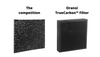
Odor removal comes down to how much carbon a filter holds and how long the air stays in contact with it. Almost every air purifier on the market advertises a carbon filter. Most of them carry a thin carbon-coated fabric sheet weighing under half a pound, which takes the edge off a mild smell for a few weeks and then stops working. Carbon mass is the specification that separates a purifier that fixes an odor problem from one that briefly masks it.
In addition to the test results above, here are other factors to look for.
Ask for pounds, not for whether it has carbon. Every TrueCarbon filter carries over three pounds of granular activated carbon, roughly six times what sits in a typical combination filter. Carbon works by adsorption, meaning gas molecules stick to the surface inside its pores. When those pores fill, the filter is finished. More carbon means more pore volume, which means longer before the smell comes back.
Weight alone is not enough. Carbon has to be packed densely enough that air cannot find a path around it. TrueCarbon uses a granular bed 2.2 inches deep with no gaps for air to slip past unfiltered. A loose or shallow bed lets air pass through too quickly for the molecules to be captured, which is why contact time matters as much as quantity.
This is also why loose pellets in a tray or a thin coated mesh underperform a packed bed of the same nominal weight.
Plain activated carbon adsorbs most household odors well and struggles with a few important ones. Formaldehyde is the significant example. Its molecules are small and light, and untreated carbon holds them poorly.
TrueCarbon filters include potassium permanganate alongside the granular carbon. Permanganate works by oxidation rather than adsorption, chemically converting compounds instead of trapping them, which extends the range to formaldehyde and other light aldehydes. Very few consumer purifiers carry it, and it is the reason our Intertek results show formaldehyde removal rather than only the easy compounds.
A purifier rated for 275 square feet running in a 500 square foot room is cleaning part of it. Match the coverage figure to your space, and if the odor source is continuous rather than occasional, size up.
| Odor | What it actually is | What removes it |
|---|---|---|
| Cigarette and cigar smoke | Particles plus hundreds of gas-phase compounds. The smell is the gas half. | Heavy carbon. HEPA takes the particles and leaves the smell. |
| Musty and mildew | Microbial VOCs released by mold as it grows. | Carbon. Also fix the moisture, or it keeps being produced. |
| Pet and litter box | Ammonia and sulphur compounds, plus dander as particles. | Carbon for the smell, HEPA for the dander. Our Intertek results cover ammonia. |
| Cooking | Aerosolized oils, limonene, and combustion byproducts from gas stoves. | Carbon. Ventilation first where you have it. |
| New furniture, paint, flooring | Formaldehyde, toluene, and other VOCs off-gassing. | Treated carbon. Plain carbon holds formaldehyde poorly. |
| Mothballs | Naphthalene or paradichlorobenzene, both gas-phase. | Carbon, and remove the source. This one is persistent. |
| Old house smell | Usually accumulated musty VOCs in soft furnishings and building materials. | Carbon, plus ventilation and humidity control. |
If your concern is dust, pollen, or dander rather than smell, you want HEPA instead. See our AirMend HEPA purifiers. If you have both problems, running an AirMend and a TrueCarbon in the same room outperforms a single combination unit, because a combination filter shares its space between HEPA media and carbon and carries a fraction of each.
Heavy carbon in a tabletop machine. Serious carbon filtration has usually meant large commercial equipment. TrueCarbon puts over three pounds of granular carbon in a unit that sits on a side table, and the 270C covers up to 475 square feet. You do not need to give up a corner of the room to get real gas-phase filtration.
Potassium permanganate as standard. The treated carbon extends removal to formaldehyde and other light compounds that plain carbon holds poorly. Almost nothing in the consumer category includes it.
Published third-party results. Our VOC removal was tested by Intertek under AHAM AC-4-2022, the standard method for assessing chemical gas reduction by a room air cleaner. The ammonia, formaldehyde, and limonene, toluene and heptane charts on this page are those results. Our founder, Peter Mann, chairs the AHAM Air Cleaners Council, the group that oversees these standards.
Named best for odors by Business Insider in 2026, from a field of more than forty air purifiers tested.
No ozone, no ionizer, no UV. Mechanical and adsorptive filtration only, and CARB certified. Ozone generators are sold aggressively for odor removal because ozone masks smell by reacting with it. It is also a lung irritant, and the reaction can produce formaldehyde as a byproduct.
Assembled in Radford, Virginia, using a brushless motor we design in house, with support in the same building.
A carbon air purifier does. A HEPA-only purifier does not, regardless of price. Smells are gas molecules and HEPA is a mechanical mesh built to trap particles, so the molecules pass straight through. If odor is your reason for buying, check the specification for activated carbon and check how many pounds of it the filter holds.
The one carrying the most carbon for your room size. Because there is no certified rating for gas removal, carbon weight and bed depth are the practical proxies. Look for pounds of granular carbon rather than a carbon-coated sheet, a packed bed rather than loose pellets, and treated carbon if formaldehyde or new-furniture smell is part of the problem.
They do different things. Sprays, gels, and plug-ins add a fragrance that covers the smell, and the original compounds are still in the air. Activated carbon removes the molecules by adsorbing them onto its surface. Baking soda works on the same principle and holds a very small amount by comparison. If you want the smell gone rather than covered, carbon is the mechanism.
In a small room you may notice a difference within about 15 minutes. Larger rooms take proportionally longer. The variable that matters most is whether the source is still there. With the source removed, a correctly sized carbon purifier clears a room within hours. With the source still producing, the purifier holds the level down rather than eliminating it.
It will make the room livable while you look, and it will not find the source for you. Start with the usual hiding places: under and behind appliances, drain traps in rooms nobody uses, the bottom of cabinets, and anywhere water has previously leaked. A musty smell with no visible cause usually means moisture in a wall, floor, or crawlspace. Run a carbon purifier in the meantime.
Carbon will. This is the clearest case for heavy carbon, because cigarette smoke is a large gas-phase load and thin carbon saturates against it within weeks. A HEPA purifier in the same room lowers the particle count and leaves the smell untouched, which is why people conclude their purifier is broken when it is doing exactly half of what they needed.
Activated carbon adsorbs naphthalene and paradichlorobenzene, the two compounds used in mothballs. This is one of the more persistent household odors because the compounds sublimate slowly and soak into fabric and wood, so removing the source is essential and the purifier addresses what is already in the air. Expect it to take longer than a cooking smell.
Untreated carbon holds formaldehyde poorly, because the molecule is small and light. Treated carbon does considerably better. TrueCarbon filters include potassium permanganate, which works by oxidation rather than adsorption and converts the compound rather than trapping it. Our Intertek testing under AHAM AC-4-2022 includes formaldehyde specifically for this reason.
About 12 months in typical use, and sooner where the odor load is heavy or continuous. Carbon saturates rather than clogging, so a spent filter looks identical to a new one and there is no visual warning. Treat the return of a smell you had under control as the replacement signal. See our replacement filters.


